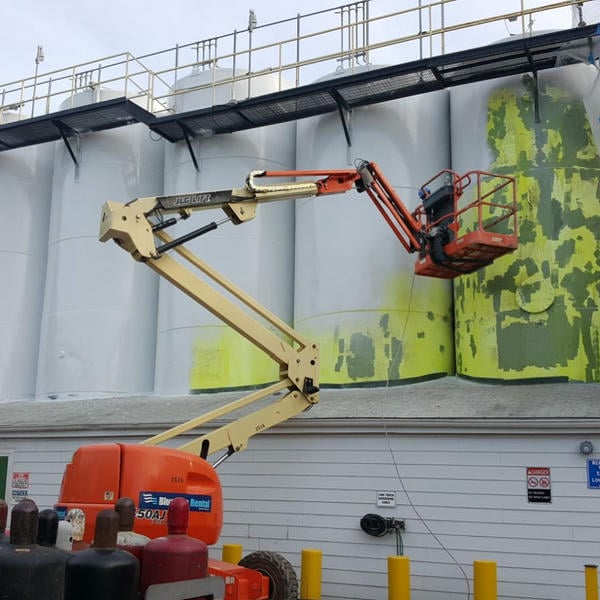
Industrial storage tanks are easy to overlook when they are doing exactly what they are supposed to do. That is also why industrial tank recoating tends to slide down the maintenance list until the problem is impossible to miss.
They sit outside or inside the facility, go through daily operating cycles, and may receive little attention until rust or coating failure becomes obvious. By that point, what could have been routine maintenance may require significantly more surface preparation and a larger industrial tank recoating project.
The better approach is to watch the storage tank coating itself for early signs of tank coating failure, before the protection it provides breaks down.
Corrosion does not always begin as a large rusted section.
Often, the first signs show up around welds, seams, bolts, edges, fittings, or areas where the coating has been scratched or damaged.
Those small spots matter because once bare metal is exposed, moisture and the surrounding environment can continue attacking the surface.
A few isolated areas do not necessarily mean the entire tank needs to be recoated. They do mean the condition should be evaluated before the affected area grows and a spot repair turns into a full industrial tank recoating job.
Peeling, flaking, blistering, and cracking are more than cosmetic problems.
They can indicate that the existing coating is no longer properly bonded to the surface. Painting directly over loose or failing material may improve appearance temporarily, but it does not correct the condition underneath.
A professional industrial tank recoating project should first determine why the existing system is failing and how much of it needs to be removed.
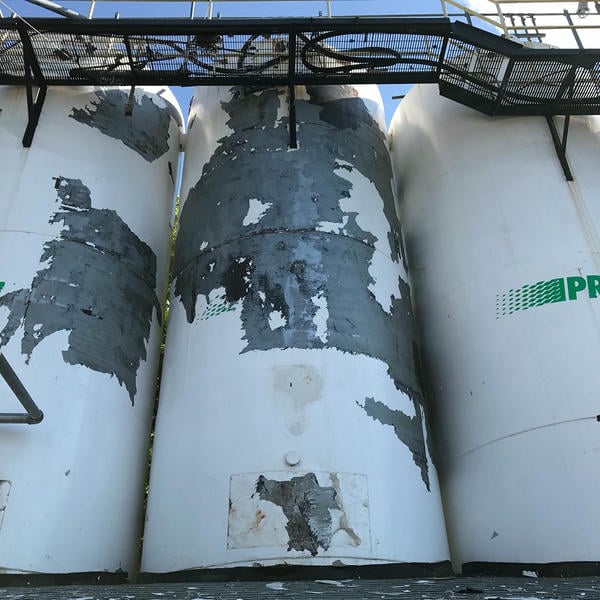
Outdoor tanks are exposed to sunlight, rain, temperature changes, moisture, and airborne contaminants.
Over time, coatings naturally age. One common sign is chalking, where the surface develops a powdery residue as the coating deteriorates.
Fading by itself does not always mean immediate recoating is necessary, but when it appears together with chalking, exposed areas, corrosion, or cracking, it is a good reason to inspect the storage tank coating more closely.
Tank maintenance often involves more than painting.
Welding, piping changes, structural repairs, new attachments, or mechanical modifications can remove or damage the protective coating around the work area.
Those sections should not be ignored simply because the rest of the tank still looks good. Exposed or damaged areas may need to be prepared and recoated so the protective system remains continuous. Scheduling that touch-up work as part of the repair, rather than waiting for the next full recoat, keeps bare metal from sitting exposed in the meantime.
A coating that performed well for years may no longer be the right system if the conditions around the tank have changed.
Changes in chemical exposure, moisture, temperature, cleaning practices, or nearby operations can affect how a coating performs.
That is why industrial tank recoating should not automatically mean applying the same product that was used previously. The current conditions should be considered first.
Older facilities sometimes have tanks with limited maintenance records.
Facility managers may not know when the tank was last painted, which products were used, or what surface preparation was completed.
In that situation, visual inspection becomes especially important. The existing coating condition, corrosion, adhesion, and substrate all need to be considered before new material is applied.
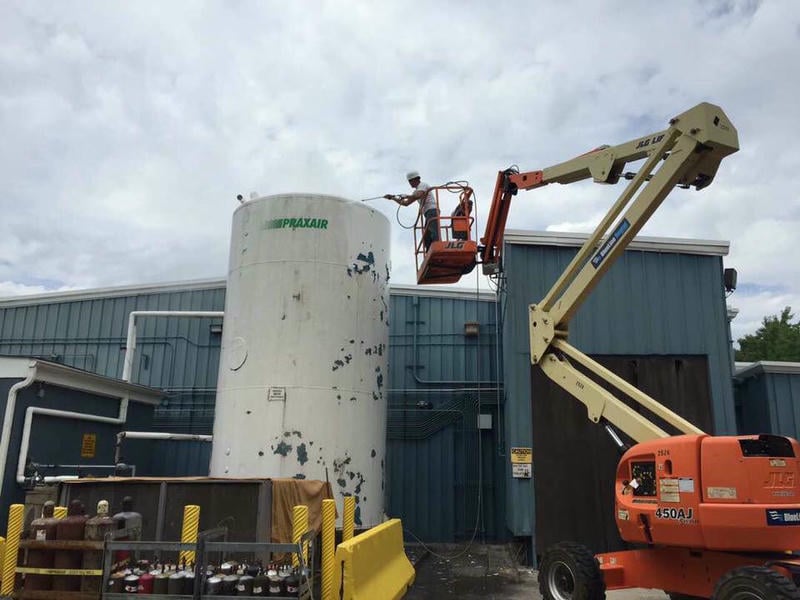
The best time to evaluate a storage tank is before large sections of the coating begin separating or corrosion becomes widespread.
A professional tank coating inspection can help determine whether the tank needs localized repairs, surface preparation and touch-ups, or a complete industrial tank recoating project.
REFF Services has more than 20 years of experience providing industrial tank painting, industrial tank recoating, and surface-preparation services for facilities in Maryland, Washington DC, and Northern Virginia. Our team can assess the condition of coated surfaces and develop a recoating plan based on the tank, environment, access requirements, and operating schedule.
Share this post: